Friday, November 22, 2019

Kids, Then and Now


Roman Griffin Davis, Taika Waititi and Scarlett Johansson as child, imaginary playmate and mother in Jojo Rabbit

Early in Taika Waititi’s new film, Jojo Rabbit, the title character (Roman Griffin Davis) walks through his hometown in World War II Germany. It’s a merry gambol as he skips along, accompanied at times by his imaginary playmate, Adolf Hitler (Waititi). Later in the film he takes a very different journey. The Allies are breaking through the town’s defenses, and he darts from one hiding place to another, not just at the street level, but sometimes racing through the basements of bombed-out buildings. His first journey is taking him to a Hitler Youth summer camp where he hopes to become the ideal Hitlerjugend, defending the fatherland from the horrors of Communism and Judaism. The later journey is a return to his home, where he fears the girl he’s come to love, a young Jewish woman his mother has hidden from the Nazis, may have been hurt by the bombing. The difference between those journeys is the story of Jojo Rabbit, an audacious little film that sets out to defang Fascism by treating it as a joke.
That’s not to say the film ignores the threat posed by the Third Reich. When Jojo first discovers Elsa (Thomasin McKenzie) hiding behind a wall in his late sister’s room, he threatens to turn her in, believing his government is right in sending Jews to the camps. She blackmails him into keeping silent by pointing out that her discovery will necessarily lead to his mother’s execution for hiding her. As events unfold, that threat turns out to be very real. Later there’s a tense scene as the Gestapo searches the house looking for anything that might implicate Jojo’s mother in the Resistance.
With the exception of a few scenes, Jojo Rabbit is a child’s view of the war. The boy’s embrace of Fascism is a thing of youthful enthusiasm. It’s a game, which scenes with the imaginary Hitler make clear. The Fuhrer romps through the woods with Jojo and at one point turns up in a Native American headdress. Even as he spouts anti-Semitism there’s nothing scary about him until Jojo’s relationship with Elsa makes the boy question his youthful values. Only then does the imaginary playmate become something demonic.
This juvenile approach is a good fit for Waititi’s irreverent, improvisatory humor. This is a man who, with co-writer Jemaine Clement, created what seemed the definitive comic take on the vampire mythos in What We Do in the Shadows (2014) and then topped himself with the recent TV versions, including the funniest beheading since Monty Python dispatched Mary Queen of Scots. He also breathed new life into the Marvel cinematic universe with Thor: Ragnarok (2017), a film that managed to combine galaxy-sweeping action with a tongue-in-cheek approach. Essentially, he’s a master at having it both ways. With the Thor film, he embraced and kidded the genre simultaneously.
He does pretty much the same thing with the wartime thriller in Jojo Rabbit. He’s assembled some skilled comic actors — Sam Rockwell, Rebel Wilson, Alfie Allen — to make the Nazis look ridiculous, while also using Scarlett Johansson, in a powerful and very sympathetic performance as Jojo’s mother, Rosie, to underline the more serious issues at hand. Johansson’s Rosie is both a dedicated Resistance fighter and the ideal mother. In one of the few scenes not shot from Jojo’s point of view, she confides in Elsa that she’s horrified by her son’s embrace of Fascism, but she wants him to realize how wrong that is for himself (there’s also a practical reason for that; would you really want to trust a 10-year-old with secrets that could get you killed?). For all the tensions of her Resistance work, however, when she’s with Jojo she’s really with him. She helps get him through his youthful insecurities and often makes him feel they’re the only two people in the world. There’s a particularly charming scene in which she acts out a dance scene, playing both her husband and herself before getting Jojo to dance with her despite a limp from an injury sustained at the youth camp. She’s teaching him to survive, which proves to be a very valuable lesson as the plot develops.
The film has been criticized for not attacking Fascism vehemently enough. I can understand that. In the current political atmosphere, anything short of a full-on denunciation can seem a betrayal. But I wonder if Waititi’s comic derision isn’t a more effective tool, at least cinematically. Yes, he leaves out the more serious attacks on Judaism to focus on childish myths about Jews, but this is anti-Semitism as perceived by a child. The myths are going to have a lot more traction with him and make more sense coming out of his mouth than the faux scholarship used by the Third Reich.
The film has also been accused of showing “good people on both sides,” primarily because of Rockwell’s character, who seems more foolish than evil. I think that’s a little short-sighted. One of the key jokes about Rockwell’s character is that he’s in the closet. It’s subtle but also quite clear that there’s something between his and Allen’s characters, and the places where they’re almost caught are very funny, because they don’t sink to stereotyped effeminate humor. They’re just human. I would suggest that Rockwell’s character is an important part of the film’s moral code. The good people are gay men, Resistance members and Jews — the very people the Nazis are trying to eliminate. Jojo’s transfer of sympathies from Hitler to them is a pretty powerful journey, one you can’t help wishing would happen more in the real world.

 
High school students Eric Deulen and Alex Frost with guns in Elephant; Is this the new normal?

The second episode of The Purge’s second season takes place in the days following a Purge, the neo-Fascist government’s night of legally sanctioned murder and mayhem. It’s a little disorienting, then, to be suddenly thrown back into the Purge. Even more off kilter, the scene is done with a subjective camera in which we fight off men attacking a woman. When she tries to thank us, she realizes, we’re about to kill her, but just before we can strike the first blow, the Purge siren goes off and a title informs us that the Purge has ended and asks if we’d like to continue purging. Ben (Joel Allen), a university student who was almost killed in the last Purge, has been playing a video game. There’s a loud knocking, and he pulls back a curtain to reveal he’s in a game arcade, and another player is waiting to use the game. After a moment of hesitation, he hands the controller to a child. That may be the sickest scene I’ve ever seen on television, and I’ve watched a lot of twisted shit on TV.
There’s a similar jaw-dropping moment in Elephant (2003), Gus Van Sant’s film about a school shooting. Alex (Alex Frost) and Eric (Eric Deulen) are playing hooky, watching a TV documentary about the Third Reich, when a delivery truck pulls up on the street outside. They open the door and sign for a package containing a semi-automatic they had scouted on-line in an earlier scene. It’s that easy. In Van Sant’s film it’s just another detail in the mosaic of high school life he assembles leading up to the climactic shooting.
Elephant is a demanding but mostly rewarding film. Van Sant plays with time throughout. The camera follows various students through the school and its environs on the day of the shooting and then jumps back to the day before to show Alex’s being bullied and then spending the evening with his friend Eric. At times, we see the same event from different perspectives. Nathan (Nathan Tyson), one of the school’s leading football players, walks past a trio of young women who flirt with him casually before he goes off to meet with his girlfriend, Carrie (Carrie Finklea). Later, we play the same scene from the girls’ perspective before they go to the cafeteria. At another point, Elias (Elias McConnell), an aspiring photographer, takes a picture of John (John Robinson) in the hall as a young woman runs by. That scene plays three times, from Elias’, John’s and the girl’s perspectives.
Throughout the film, Van Sant picks up snippets of conversation and stray details that capture the students’ problems. The running girl, Michelle (Kristen Hicks), has body problems. Her gym teacher disciplines her for wearing long pants to gym class. When Michelle goes to the locker room, she changes in an awkward way designed to keep the other girls from seeing her body. Nathan and Carrie quarrel about their plans for later. He wants her to find some girls to bring as dates for his friends, but she’s not too keen on letting the other young women be exploited. The lunching trio discuss boys and clothes and going to the mall. Then they all go to the women’s room to throw up what little they’ve had for lunch.
 That last detail is almost too much. It feels like a gag and seems to have wandered in from another film. That’s how subtle most of Van Sant’s filmmaking is in the picture. The cast of mostly non-actors or beginning actors (with effective performances in adult roles from professionals Timothy Bottoms and Mike Malloy) is very natural. It’s like you’re eavesdropping on their lives, and you have to work with Van Sant to assemble the pieces of what’s basically a cinematic puzzle.
That makes for a fascinating journey, but there’s a problem with that kind of construction. It can be very hard to come to any kind of conclusion. Playwrights like Daniel MacIvor and Caryl Churchill have made it work, and it certainly works in short films like Maya Deren’s “Meshes of the Afternoon” (1943) and Kenneth Anger’s “Fireworks” (1948). Alejandro G. Iñarritu got away with it in 21 Grams (2003) by not revealing how his key characters were related to each other until almost the end. That’s not how Van Sant plays it in Elephant. Once he gets to the school shooting that brings the various characters together as victims or survivors, he has nowhere to go. The film doesn’t so much end as it just stops. It’s hard to tell exactly what could have worked there. You want to see the ultimate fate of the shooters, but almost anything that could happen feels too conventional. Ending with their arrest or escape would seem like something from another film.
There’s also a curious moment before the shooting when Alex gets into the shower and Eric joins him. Certainly, the idea of their going through some kind of purge before the final act of violence makes sense. But then they start kissing, because, as Alex says, “I’ve never been kissed before, have you?” As much as we may think society has grown up in the last few decades, the sight of two men kissing is still heavily loaded. Although in context it’s very sad that this is the only connection these two young men can find, it reads as gay. That would certainly fit with the suggestion that both young men are responding to bullying, but I don’t think that’s what Van Sant is after. He seems to want these two to be no different from the other students (not that being gay makes them less human, but it does suggest a different story). As a result, the scene is inconclusive, and if it doesn’t quite sink the film, it seems almost too much of a question mark to leave with the viewer.
What keeps those inconclusive moments from ruining the film is the powerful nexus of meanings Van Sant has created within the rest of the picture. When Eric confronts the school’s principal during the shooting, he berates him for not supporting him when he complained about being picked on and then adds, “Anyway, Mr. Luce, whatever. You know there’s others like us out there, too.” Through the course of the film, Van Sant has created a world where emotionally absent parents, disengaged authority figures, bullying and bulimia are the new normal, along with violence and the ready availability of firearms. That sense of normality is really the film’s most terrifying element.

Tuesday, October 22, 2019

Queens


 Three queens — Barrow (Robert James-Collier) in Downton Abbey, John du Pont (Steve Carell) in Foxcatcher and Hubert (Xavier Dolan) in I Killed My Mother —
 the good, the bad and the much, much better

When the first season of Downton Abbey originally aired, I told a friend how hot I thought Barrow (Robert James-Collier), the gay footman, was. “But he’s evil,” my friend protested. True, during the series’ first few seasons, Barrow was notorious for scheming to get at anybody he thought threatened to surpass his position in the household. At times — as when he tried to embarrass the new valet, Bates (Brendan Coyle), who limped because of a wound sustained in the Boer War — he was downright vile.
But writer Julian Fellowes contextualized Barrow’s plotting early on. The revelation of his homosexuality came in a particularly painful scene, when he was rejected by the Duke of Crowborough (Charlie Cox), with whom he had enjoyed a sexual relationship until the Duke started courting the upstairs family’s eldest daughter, Lady Mary (Michelle Dockery). It was one incident, but it set the stage for the depiction of Barrow's sexuality during the repressive years of the early 20th Century. Although hardly enough to let Barrow off the hook for his worst misdeeds, it at least explained his excessive concern with his place in the household. As a social outcast, it was all he had, particularly since for the series’ six-season run he never had a love interest.
In the new feature film version of Downton Abbey, Barrow is back. He's risen to the post of butler with the retirement of family standby Carson (Jim Carter) at the series' end. Although the film's principal focus is the turmoil wreaked by the announcement that King George V and Queen Mary will be visiting the Abbey, writer Julian Fellowes has given Barrow a subplot. When Lady Mary asks Carson back to help with preparations, the younger butler decides to take the weekend off and accompanies one of the king's valets, Richard Ellis (Max Brown), on a trip to York. There he's picked up in a bar and taken to an underground gay party. It could be a scene out of a gay pulp novel as he walks in on a large room filled with men dancing and making out, but there's nothing smarmy or exploitative about it. Rather, this is Fellowes’ presentation of what life was like for gay men outside the big cities in the period between the wars. The scene offers the character a rare release and, once again, suggests that he's been more than just the stereotypical soap opera spoiler. There’s a liberated feel to the sequence, particularly in the shots of Barrow dancing joyously with another man, but there’s also a sadness at the shabby surroundings where gay men were forced to hide their desires.
Like the series on which it is based, Downton Abbey the film is a curious paradox. It upholds, even exalts in the notion of class distinctions with its nostalgic depiction of the upper-class Crawleys, living with style and grace on their palatial estate while served by a large staff led by champions of tradition like Carson, Barrow and the housekeeper, Mrs. Hughes (Phyllis Logan). Yet the series itself, with its strong ensemble and the equal disposition of drama between upper- and lower-class characters, dissolves those class differences on a meta-theatrical level. When it comes to playing their roles, suffering nobly or dashing off humorous lines, all good actors are created equal.
This also seems to extend to the film’s (and series') handling of social issues. Fellowes does not flinch from depicting the negative side to the treatment of women, LGBTQ peoples and racial minorities during the early 20th century. In the film, the Crawleys' younger daughter, Edith (Laura Carmichael), bemoans the fact that marriage to a marquess has meant giving up her career as a magazine publisher. As a married noblewoman, her only acceptable job is serving on committees. A Crawley relative serving the royal family reveals that her personal maid is actually her illegitimate daughter. It's probably stretching credibility a bit that the Crawleys, even the Dowager Countess (Maggie Smith), accept the fact that the illegitimate child will be their cousin's legal heir, just as they accepted Edith's adoption of her own illegitimate daughter. Through the series, the family was also amazingly open to Barrows' sexuality. Only some of the servants were less trusting. Had it not been for the support of the two lady’s maids, tolerance would have seemed a class-based virtue.
In a sense, Downton Abbey is a fantasy, a look at a world that no longer exists and probably never really did. It's a very entertaining fantasy. Any opportunity to see Smith is to be treasured, particularly when she's matched with a wonderful sidekick-cum-sparring partner like Penelope Wilton, who plays the mother of Mary's late husband. The entire cast is a joy to watch, and James-Collier should be commended for his commitment to his character — homosexuality, rough edges and all. Although the actor has complained about being typecast, he still gives the performance his all, and the film would be far weaker without his presence.
Though some have complained that the film version is just an expanded episode of the original series, that’s not entirely true. There’s a broader sweep to some of the filmmaking that makes big events like the reception for the king and queen and a royal ball suitably impressive. And even without those expanded production values, a return to the series’ virtues is hardly a bad thing. There should always be room in the movies for grace and the delicate playing of expert actors.
Yet, there's also something a little unsettling about the fantasy, particularly in a world where we're seeing the ravages of inherited wealth and where labor has become just another means of exploitation. I wonder how generous we'd be toward the series if it were set on a Victorian estate in Africa or an antebellum plantation in the American South, where the genteel white ruling family would treat their slaves with dignity, help those outside the family estate when they could and weep picturesquely for those beyond the range of their largesse.


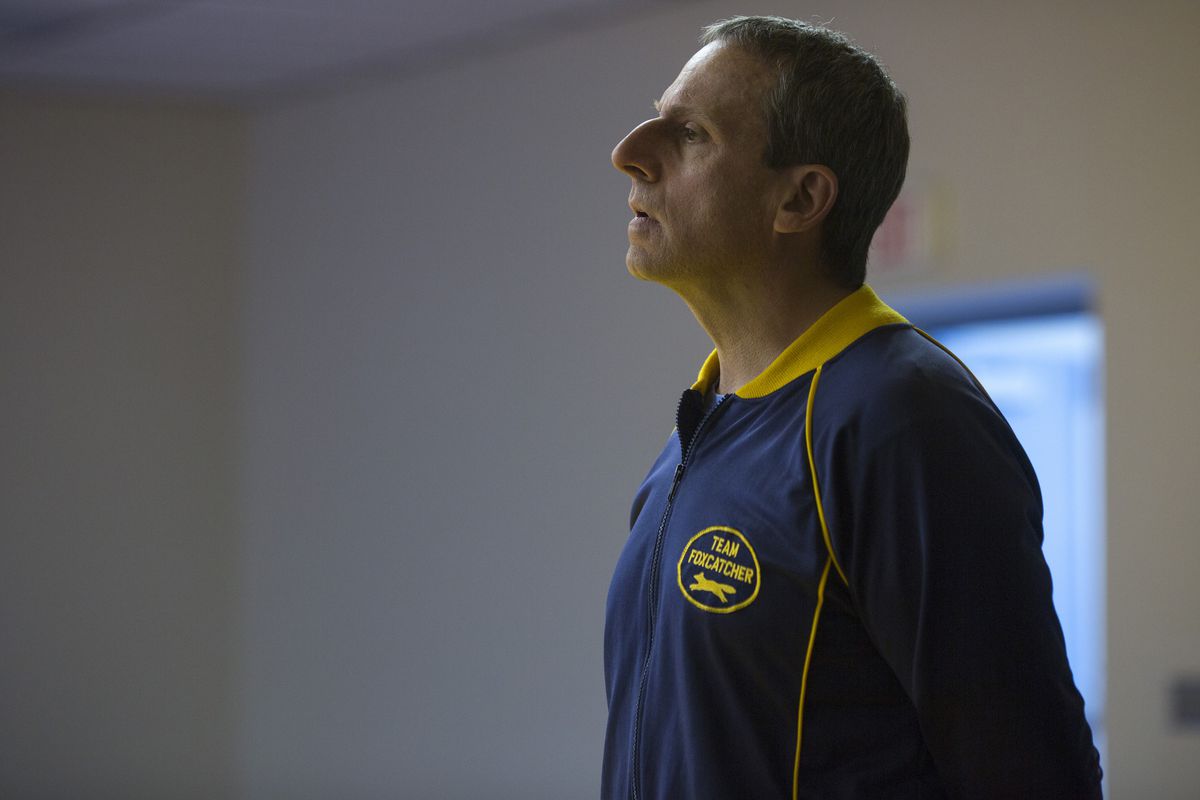
Steve Carell, Channing Tatum, Mark Ruffalo and all that makeup in Foxcatcher

Bennett Miller’s 2014 Foxcatcher offers a far more jaundiced view of inherited wealth. The film purports to depict the real-life events leading to John du Pont’s murder of David Schultz, the coach of a wrestling team he sponsored. I say “purports” because the film takes a very liberal approach to facts that ultimately makes it less than satisfying.
The du Pont case is a perfect vehicle for an attack on the privileges of wealth. The man had exhibited signs of mental decay for years. In his 2014 memoirs, David’s brother, Mark, said that du Pont seemed off from the moment he first met him before accepting a job as assistant coach to a team du Pont was sponsoring  at Villanova University. Even before that, du Pont’s one marriage had ended when he physically attacked his wife. In the months leading up to David Schultz’ 1996 murder, du Pont’s behavior had become increasingly erratic. He believed CIA agents were lurking in his mansion’s walls and that David was part of an international conspiracy to murder him. All of this took place eight years after Mark had left du Pont’s employ following the 1988 Olympics.
Understandably, many of the events in the case were streamlined for storytelling purposes. Mark’s various telephone conversations and an earlier meeting with du Pont in a hotel are compressed into a single meeting at du Pont’s mansion. His living arrangements — first at an apartment he rented near Villanova and then in a room in the chalet on the estate’s grounds — became a single stay at the estate, where he has free run of the chalet. In addition, David’s murder seems to take place shortly after Mark’s departure.
All of this could be written off as dramatic license, a necessary tightening of events for dramatic effect. But events are also arranged to create the distinct impression that du Pont’s mental problems spring from repressed homosexuality. As Mark and du Pont become friends, du Pont asks the younger man to wrestle with him in a late-night session during which the film clearly implies that du Pont sexually molests him (Mark Schultz vehemently denies anything of the sort happened). After that, Mark’s behavior begins to deteriorate as he starts drinking, snorting cocaine and overeating so badly that he initially fails to qualify in his weight class at the pre-Olympic trials. His friendship with du Pont disintegrates, and his departure from the estate after the Olympics seems to result from that. With the compression of time between his leaving and David’s murder, it’s almost impossible to see the crime as motivated by anything other than sexual rejection. Du Pont, then, joins a long line of cinematic killer queens, some presented sympathetically, some as two-dimensional plot devices.
I must confess that at times I don’t understand straight filmmakers, particularly when they depict LGBTQ peoples. It’s not that I think only gay filmmakers can depict gay characters honestly. There have been many sensitive depictions of homosexuality by straight writers and directors (like Julian Fellowes’ in Downton Abbey). Nine years before they made Foxcatcher, director Bennett Miller and writer Dan Futterman did a terrific job with Capote (2005), about the famous author’s relationship with killer Perry Smith that led to his writing In Cold Blood. They even gave him a hot partner by casting Bruce Greenwood as Jack Dunphy, the novelist and playwright who lived with him from 1948 until Capote’s death in 1992.
Why, then, did they add a gay element to Foxcatcher that not only cheapens the story, but also obscures the issues related to du Pont’s case? There’s a slight precedent for the invention in a sexual harassment suit brought against him by another wrestling coach with whom he had worked at Villanova. But making sexuality the center of du Pont’s breakdown in Foxcatcher takes the focus off one of the most interesting aspects of the murder case, the way du Pont’s privileged position as heir to one of the U.S.’ greatest fortunes insulated him from any kind of intervention as his behavior grew increasingly erratic.
Nor does it help that two of the leading players seem insulated from the audience. As du Pont, Steve Carell wears a two-hour makeup job to capture the character’s facial contours and performs with dead eyes and a persistent head tilt to the back that creates an almost perpetual sneer. It’s the kind of one note, overly made up performance that wins people Oscar nominations but never really comes across as totally human. That’s particularly disappointing given Carell’s stronger work in comedies like Little Miss Sunshine (2006) and Crazy, Stupid, Love (2011). He was more expressive as a puppet in Welcome to Marwen (2018). Channing Tatum, who brings less to the table than Carell, plays Mark Schultz behind some extensive make-up, as well. The plugs used to give him a wrestler’s nose and plumpers that fill out his jaw make him even less expressive than usual.
Of course, extensive makeup doesn’t have to get in the way of a performance. Samantha Morton manages to bring Alpha to life each week on The Walking Dead despite playing many of her scenes behind a full-face mask. As David Schultz in Foxcatcher, Mark Ruffalo is also heavily made up while working with a new hairline, 30 extra pounds and a full beard, yet he manages to turn in a fully realized performance. Then again, he’s even done credible work acting through motion-capture technology to play The Hulk in Marvel’s superhero films. He doesn’t get all the acting honors. Vanessa Redgrave may have only three scenes as du Pont’s mother, but she easily creates a strong portrait of the powerful, demanding woman whose withheld affections contributed to her son’s mental problems. Of course, she’s been acting for so long and at such a high level of achievement it sometimes seems there isn’t a script or a director that could defeat her.
Lord knows, Miller tries hard. The filming style that worked with Phillip Seymour Hoffman’s flamboyant interpretation of Truman Capote — slow, long takes with lots of long shots and a washed-out, wintery palette — isn’t as effective when two of your leading players are doing everything they can to repress any level of humanity in their work. As Carell’s du Pont leads Tatum’s Mark Schultz into a life of privileged dissipation — introducing him to cocaine, conspicuous consumption and gay groping — the film seems less a dramatic reinterpretation of a real-life murder case than a slowed-down version of “Boys Beware” (1961), the infamous educational film warning young men about the dangers of homosexuality.

Xavier Dolan and Anne Dorval connect on an almost genetic level in the wonderful I Killed My Mother

It’s a natural rite of passage that many young people outgrow their parents. This can be particularly telling for people on the LGBTQ spectrum, whose discovery of their sexuality often means a rejection of their parents’ heteronormative worlds. That’s the twist French-Canadian writer-director-actor Xavier Dolan brings to the coming-of-age story with his first feature, I Killed My Mother (2009). Written when Dolan was 16 and filmed when he was just 20, the piece is an impressive, often shocking feature debut.
In the semi-autobiographical tale, Dolan is Hubert, a rebellious high-school student who underachieves at school despite showing promise as a writer and artist. His mother (Anne Dorval) is a middle-class drudge who can do nothing right in his eyes, while his father is largely absent, having left wife and child after seven years upon realizing that he just wasn’t cut out to be a parent. Hubert is developing tastes of his own, which makes it hard for him to deal with his mother’s bourgeoise affectations. He’s also come out to himself without bothering to tell her. She only learns he’s gay when she runs into his boyfriend Antonin’s mother at a tanning salon.
Given Dolan’s youth and the autobiographical elements of the story, you might expect this to be a one-sided condemnation of parental failings. It isn’t. One of Dolans’ great gifts as a director — in this and in later films like Heartbeats (2010), Laurence Anyways (2012) and Mommy (2014) — is an ability to capture privileged moments when characters drop their guard and reveal themselves as they really are. He’s movingly generous to his characters and his fellow actors in that. After almost an hour of showing Dorval’s Chantal at her worst, leading to her shipping her son off to a Catholic boarding school so she won’t have to deal with him, Dolan gives her a beautiful moment. Hubert tells her not to bother walking him to the school bus stop, then shoots back at her “What would you do if I died today?” As he walks off, her anger fades and she simply says, “I’d die tomorrow.” It’s a heartbreaking moment. For all their differences, there’s a tie the two can’t escape. That’s what makes their disagreements so feverish.
In early scenes, the fights between mother and son are amazing bits of psychodrama that manage to be both horrifying and very funny. Each knows how to get to the other and doesn’t hesitate to go for the jugular just to score points. Yet they also try. In one extended sequence, Dolan fixes his mother breakfast and promises to have dinner waiting for her when she gets back from the tanning salon. He even does the dishes, but by this point she’s hurt and angry at having to find out he’s gay from a virtual stranger. She invites him to ride with her to the store so he can rent some videos while she’s shopping, then gets angry when he takes too long. The fight escalates to the point that she strands him. That sets the stage for her shipping him off to boarding school.
Like the young Orson Welles, Dolan doesn’t know what you can’t do, so his framing and cutting are often surprising. When Dorval brings home a new lampshade in a ghastly animal print, he focuses the shot on Hubert sitting on the sofa. You see the lampshade in her hands, but not her face. After he forces himself to compliment her, Hubert stands and takes her hand, which suddenly becomes the shot’s focal point. With almost any other director that would be just wrong, but within the context of the scene, it’s very moving. Throughout the film Dolan cuts freely to Hubert’s dreams and memories. Initially some of those shots are confusing, but they all come together in the end. There are shots of a child running freely on a grassy beach that are finally contextualized when Hubert runs away to the same beach near the house where he spent his early childhood at a time when he and his mother always seemed to be in synch.
At other times the filmmaking is almost breathtaking, reminiscent of the early work of Truffaut and Godard. The boyfriend’s mother asks Hubert to paint her office in the style of Jackson Pollock. The sequence is all quick cuts, culminating in the two men making love in a rush of excitement mirrored in the editing. On his first weekend home from school, Hubert goes dancing with a new friend (Niels Schneider, who would go on to play the disruptive lust object in Heartbeats) who introduces him to speed and then kisses him. Instead of staying to make out, Dolan rushes home to share his feelings with his mother in an orgiastic rush of words. It’s a terrific acting feat that once again captures the character’s desperate need to connect with his mother. Dorval gets a similar scene later on when she tells off the principal at the boarding school. Both scenes are thrilling. You may find yourself holding your breath for fear that they won’t pull it off. But they do, and it’s wonderful.
Dolan doesn’t hold back from displaying Hubert’s faults. At times the young man is a little shit. When he goes at his mother, you can see him going too far, and after a while you may want to shake him just to get him to ease up on her. Dolan even lets the boyfriend (the coltish young Francois Arnaud, who’s much more open here than in his later television work) call Hubert out for his selfishness. As in the rest of the film, the scene is a mix of frustration and love. Antonin really cares for this kid, but at times he just can’t put up with him. The much-reviled mother tracks them down and meets Antonin for the first time. When she goes off to take care of her son, who’s wandered off to the beach, the pain in Arnaud’s face is real. For all the friction between mother and son, how can he ever compete with their connection? How can anybody?

Wednesday, September 11, 2019

Intertext and Out the Other


Leonardo DiCaprio prepares to take on Nazis, while Margot Robbie’s Sharon Tate is about to catch one of her movies in Quentin Tarantino’s Once Upon a Time…in Hollywood.

At one point in Quentin Tarantino’s cinematic fairy tale, ONCE UPON A TIME…IN HOLLYWOOD (2019), movie star Rick Dalton (Leonardo DiCaprio) and his stuntman/best friend Cliff Booth (Brad Pitt) drive past a movie theatre showing The Night They Raided Minsky’s (1968). It’s easy to miss, and most viewers who even bother to notice would dismiss it as a just a blip. But when it comes to cultural references in Quentin Tarantino’s movies there are no blips. This is a very subtle comment on the future of actors like DiCaprio’s Rick Dalton. The Night They Raided Minsky’s marked the film debut of Elliott Gould, one of a handful of actors who, in the late 1960s and early 1970s, would change the face of stardom in Hollywood. The strong-jawed aging pretty boys like Dalton would be out in favor of leading men who looked more like real people. It’s a small moment, almost a throwaway, but it indicates how thoroughly Tarantino’s film is grounded in Hollywood’s past. For Tarantino, film history, no matter now trivial to some, is part of his cinematic language.
This is all a form of intertextuality, the use of other texts to shape a text's meaning.  It's a practice that dates back to the earliest literary forms, though the term was not coined until 1980, when Julia Kristeva published Desire in Language: a semiotic approach to literature and art. Later scholars have suggested that every word is an intertext, having derived its meanings from appearances in other texts. This would suggest that all artistic creations are part of one ever-evolving master creation, and indeed, Tarantino's works suggest the existence of some master "film" encompassing all works in the medium.
The movies’ past has always figured heavily in Tarantino’s works and not just in references to culturally approved “masterpieces.” Rather, he exults in movies that move, the trashier action and horror films, particularly those that came along after the arrival of the ratings system and the proliferation of home video. In the case of ONCE UPON A TIME…IN HOLLYWOOD, he makes his central character a film and TV actor fighting to keep his career alive after leaving a successful Western series. Rick Dalton keeps himself going playing mostly villains in TV guest shots (Tarantino even cuts him into an episode of The FBI in place of original guest star Burt Reynolds, whose friendship with stuntman Hal Needham inspired the relationship between Dalton and his stunt double). His agent (Al Pacino, in a very funny cameo) advises him to sign for a series of Italian films, and Dalton returns from Italy the night of the Manson murders.
Running parallel to his story are the last days of Sharon Tate. Played by Margot Robbie, she’s an almost beatific figure who loves to dance and hug people. At one point, she watches one of her movies, the Matt Helm thriller The Wrecking Crew (1968), and giggles as the audience responds to her performance. Robbie’s resemblance to Tate is so strong Tarantino doesn’t have to cut her into that film. He just shows scenes from the original, and it works. Tate has a tenuous connection to the Rick Dalton plot. She and husband Roman Polanski are renting a house next to his. Of course, in the real world, their house on Cielo Drive didn’t have any close neighbors, but this isn’t reality; it’s fantasy. Without spoiling anything, I’ll just point out that Tarantino is the director who had Adolph Hitler killed in Occupied France in Inglorious Basterds (2009).
In Tarantino’s fantasy Hollywood, Rick Dalton appears in films and TV shows that originally starred not just Reynolds but actors like Joe Don Baker and Ty Hardin. It's interesting that Tarantino, a long-time champion of B- and even Z-grade movies, fills his picture with references to the cheap and ephemeral while offering relatively little screen time — and no on-screen references — to the more critically respectable works of Tate's husband, Roman Polanski. When Rick finally meets the people next door, they connect through Tate and former beau Jay Sebring's love of one of Rick's sketchier films, The 14 Fists of McClusky. Tarantino has always been a subversive filmmaker, and the focus on the Rick Daltons of the world seems his way of subverting the pantheon of “great” films, giving the movies he loves a greater place in the great master film of which Once Upon a Time…in Hollywood is a part.
Tarantino displays a lot of affection for marginal figures like Dalton and Booth. When Dalton films the pilot for the TV Western series Lancer, Tarantino lets the character connect with the series' star, James Stacy (Timothy Olyphant). They have a sweet scene together discussing Dalton's career, and when the shoot is over, Tarantino shows Olyphant getting on his motorcycle, a bittersweet reference to the accident that would cost Stacy his career. A more cynical director might have thrown in a reference to Stacy’s later conviction for child molestation, but Tarantino chooses to focus on him as part of a lost Western tradition the movies tried to keep alive. It’s a fantasy Once Upon a Time…in Hollywood perpetuates in its final scenes…but spoilers.
Sadly, Tarantino’s generosity doesn’t extend to everybody depicted in the film. At times, he’s a bit too much the gadfly for the picture’s own good. During a flashback to Dalton’s guest shot on The Green Hornet, he depicts a confrontation between Booth and that series’ star, Bruce Lee (Mike Moh), who’s portrayed as a preening, egotistical fool. For plot purposes, its important that Booth prove to be a better fighter than Lee, but making Lee a buffoon into the bargain seems gratuitous and even racist, not to mention a little shallow. It’s a quick and easy way to get into the sparring match and keep the audience on Booth’s side.
Lee, at least, has a stalwart cult of fans to keep his memory alive. Sam Wanamaker doesn’t. Wanamaker directed the pilot episode of Lancer, and when he first turns up it’s great to see he’s played by Nicholas Hammond, the one genuinely hot Von Trapp kid in The Sound of Music (1965) and the first live-action Spiderman, a source of many a pubescent fantasy. But within a few lines, the character starts to come across as a pretentious fop. He wants to costume Dalton’s bad guy as if he were a Hell’s Angel, and gives him a line of bull to explain the choice. Wanamaker, who was a skilled actor and one of the co-founders of England’s Globe Theatre project, deserves a lot better.
This is particularly aggravating given Tarantino’s generosity to DiCaprio and the rest of the cast. The writer-director has consistently rehabilitated careers, giving fresh life to actors like John Travolta, Robert Forster and David Carradine. And he’s directed one of the few performances from DiCaprio that doesn’t make me cringe. As a young man, DiCaprio had an electric presence, whether playing Johnny Depp’s intellectually disabled brother in What’s Eating Gilbert Grape? (1993) or the hotshot young gunslinger in The Quick and the Dead (1996). With stardom, however, his work has seemed primarily about appearances. His Jay Gatsby was a cipher in a sea of ciphers in that strange adaptation of The Great Gatsby (2013) in which only Toby McGuire’s Nick emerged as a fully realized human being. In Revolutionary Road (2008), he spent so much time demonstrating what the character was saying he never really got into his head.
He really seems to be inside Dalton’s head however. When he shoots the Lancer pilot there’s a very funny scene in which he excoriates himself in his trailer for not being able to remember his lines. Then he goes back to the set and nails his big scene. After Wanamaker and his child scene partner (the preternaturally self-possessed Julia Butters) compliment him on his work, Tarantino keeps the camera on DiCaprio. The play of emotions on his face — relief, pride, gratitude, grief — is a thing of beauty.
There’s a different kind of beauty in Tarantino’s handling of Booth’s visit to the Spahn Ranch, where he encounters members of the Manson family. The scene starts out on a lighter level. Booth picks up one of the family members (Margaret Qualley) while she’s hitchhiking and her version of hippie freedom is played for laughs. When they arrive at the ranch, she starts introducing him to the others, and there’s the least hint of a threat. That goes deeper when he decides to pay a visit to the ranch’s owner, George Spahn (Bruce Dern), whom he hasn’t seen in years. Tarantino builds the tension subtly and simply as Booth has to fight his way past Squeaky Fromme (Dakota Fanning), who’s been keeping Spahn under control with sex and drugs. Pitt’s trip to the back room where the man is sleeping and their cryptic, tense encounter is like something out of The Texas Chain Saw Massacre (1974, and is this blog turning into a giant intertextual reference itself?). You keep expecting something horrible to happen. Nothing really does, but the tension is palpable, expertly evoked through camera placement, editing and writing.
That sequence is very important to Tarantino’s overall conceit. It’s a reminder of the real threat hanging over Cielo Drive as the action moves toward the night of the murders. Without it, the film would be a mostly amiable goof on Hollywood history. With it, however, Tarantino has turned it into a stuff of Hollywood legend. The narration (by Kurt Russell) becomes not just a device for filling in information, but rather a way of telling the tale, and a very tall one it is. Tarantino turns the friendship of star and stuntman into the legend of Rick and Cliff, and when it’s time to face the truth, like the reporter in John Ford’s The Man Who Shot Liberty Valance (1964), he prints the legend.


Joe Chrest, Annisston or Tinsley Price and Cara Buono share a portentous Ferris wheel ride, while Joe Keery and Gaten Matarazzo share some great comic teamwork in season three of Stranger Things.

The seventh episode of Stranger Things’ third season opens with a tribute to Alfred Hitchcock. As a family rides the Ferris wheel at the county fair, Fourth of July fireworks go off. Mother and father look above to enjoy the display, while their daughter looks down, a clear reference to the tennis match watched by Bruno (Robert Walker) in Strangers on a Train (1951). When they ask why she isn’t watching the fireworks, the girl points to the nearby trees, which are moving unnaturally. Since these characters are outside the series’ science-fiction loop, they have no way of knowing it’s an indication that the season’s big bad, the Mind Flayer, is on the loose. Later in the episode, there’s a shoot-out in a hall of mirrors, another movie reference, this time to Orson Welles’ amazing The Lady from Shanghai (1947). That may be a bit too intertextual for some, but for movie fans references like that are just part of the thrills provided by The Duffer Brothers’ vision for the series.
Stranger Things has maintained a surprising level of achievement through its first three seasons. It centers on the relationships of a group of tweens growing up in an Indiana small town in the 1980s. All of the normal traumas of young adolescence — bullying, awakening to sexual desire, rebelling against authority — are intensified by the presence of a nearby scientific facility doing research into the paranormal. In particular, they’ve opened the door to a deadly, parallel universe called “the Upside Down,” which keeps sending a variety of nasties into the area. One escapee from the lab is more benign, however. Eleven (Millie Bobby Brown), an unnamed child and human test subject, bonds with the kids and serves as a frequent deus ex machina thanks to her burgeoning telekinetic and psychic powers.
Season three opens with most of the youngsters sneaking into the new multiplex to see Day of the Dead (1985). The film’s opening scene, in which Lori Cardille dreams she’s attacked by hands bursting out of the wall, is a perfect metaphor for the Duffers’ seres. It’s all about threats bursting through the fragile shell of reality. The problems start mundanely in this season. During a power outage, the refrigerator magnets at Will Byers’ home drop to the floor, which leads his mother, Joyce (Winona Ryder) to an investigation that unearths a Soviet lab hidden beneath the town’s new mall.
Ryder herself is something of an intertext — a one-time star who flourished during the 1980s. In a few seasons, the kids could be sneaking in to see her in films like Beetlejuice and Heathers (both 1988). The show has been something of a renaissance for Ryder, who had trouble adjusting to older roles. During the first two seasons, her Joyce was an icon of suffering and blind determination as she tried to save her son Will (Noah Schnapp), who had been kidnapped and traumatized by a creature from the Upside Down. Her storyline is a little lighter in season three, as she tentatively embarks on a romance with the town’s sheriff, Jim Hopper (David Harbour), who’s adopted Eleven and is struggling with how to parent a girl going through puberty. Even as Joyce’s investigation starts to turn up the real threat facing her family and the town, she gets a delicious comic moment telling off a government agent over the phone. It’s the kind of breathless temper tantrum at which Rosalind Russell or Doris Day were experts, and she’s right up at their level.
Stranger Things’ third season is filled with little acting gifts like that. After Eleven breaks up with her boyfriend, Mike (Finn Wolfhard) — the result of Harbour’s bumbling attempts at parenting — she starts to connect to Max (Sadie Sink), a new member of the group. Their scenes together as they share their frustration with the opposite sex and explore the joys of shopping are a delight.
Even better is the relationship between another of the tweens, the eternally dorky Dustin (Gaten Matarazzo) and one-time bully Steve (Joe Keery). In season one, Steve had been the show’s resident turd in the punchbowl. He was dating Mike’s sister, Nancy (Natalia Dyer), and standing between her and Will’s brother, Jonathan (Charlie Heaton), a relationship only the most emotionally frozen realized was TV destiny. Somewhere in season two, he lost Nancy to Jonathan but then, in an inspired, loopy bit of plotting, started helping the tweens as they fought the big bad. By season three, he’s their unofficial den mother, using his job at the new mall to break them into the movies and eventually helping Dustin investigate a radio message in Russian he picks up on his ham radio. Keery and Matarazzo are one kick-ass comic team.  Their timing should be the envy of seasoned adult comics and calls to mind the best work of Abbott and Costello and Martin and Lewis.
As the different groups of characters come closer to unearthing the Russian plot to access the Upside Down, the cultural references pile up. Steve and Dustin’s invasion of the Russian base could be a scene from Red Dawn (1984) played for laughs. Dustin and friend Caleb’s sister, Erica (Priah Ferguson), bond over their responses to My Little Pony. And in a moment of high delirium that leads to the season’s climax, Dustin finally manages to contact his long-distance girlfriend, Suzie (Gabriella Pizzolo), and enlists her help by joining her in a duet to the theme from The Neverending Story (1984).
This isn’t to suggest the season is all shits and giggles. There are some serious consequences to the storyline. In particular, Eleven gets into the mind of Max’s stepbrother, Billy (Dacre Montgomery), who’s been taken over by the Mind Flayer. Her digging unleashes memories of desertion and abuse that provide a context for his aggressive, often harmful behavior during the two seasons he’s been on the show. The memories are heartbreaking, and it’s to Montgomery’s credit that he unleashes the character’s vulnerability without descending into banality. It’s another little triumph in a series filled with wonderful little touches that flesh out the characters so both comedy and heartache have a solid grounding, no matter how far out the science fiction plotting may venture.

  Bette Davis hands Mary Astor a cigarette and an Oscar in The Great Lie.

The main intertexts in Edmund Goulding’s The Great Lie (1941) are classical pieces, which function as an emblem for the world of Sandra Kovak, the sophisticated concert pianist played by Mary Astor. The film doesn’t go much deeper than that. The pieces are used for their association with a more rarified life than those lived by the mass audience. Any further meaning they develop comes from their placement within the film. Paradigms take a back seat to syntax.
Madame Kovak’s signature piece is Tchaikovsky’s First Piano Concerto, which provides the title music and recurs as her main theme. It’s the piece she performs in Philadelphia the night she’s supposed to be in New York getting legally married to George Brent, whom she had married before her previous divorce became final, and she plays it again at the film’s end, when she realizes she can’t use the baby from their brief, unsanctified union, to win him back. As such, the crashing chords that open the piece become a signifier for Sandra’s independence, something women weren’t supposed to aspire to in popular movies of the era.
Golden Age Hollywood tended to view classical music with a combination of awe and disdain. It was high culture, something to which the mass audience had to aspire, but it was also a signifier for snobbery and foolishness, so as not to alienate that same mass audience. The studios were constantly trying to make classical musicians, particularly singers, into stars, but they always had to temper it by having them get down and dirty with popular music. When Jeanette MacDonald did a brief jitterbug with Binnie Barnes in I Married an Angel (1942), it was one of the film’s few redeeming moments, but when pianist Jose Iturbi tried to do comedy in his MGM musicals, it was downright painful.
In The Great Lie, Astor is the other woman, the sophisticated, fast-living concert pianist who briefly steals Brent from his true love, country girl Bette Davis (playing effectively against type). When Davis goes to Philadelphia hoping to see Brent, she has to deal with Astor as the soundtrack plays Wagner’s Liebestod, which any reasonably intelligent audience member would see reflecting the death of Brent’s short-lived fling with Astor. In the opening scene in Astor’s apartment, her manager plays her character’s recording of Anton Rubinstein’s Piano Concerto No. 4, a difficult, complex piece that seems to speak to her alienation from Brent’s simpler world. Later, an unwelcome visit to Davis’ farm is heralded by the sound of Astor playing a Chopin waltz, a simpler piece that seems part of Astor’s attempt to steal Davis’ domestic bliss.
The film manages to balance being relentlessly silly with being almost irresistibly entertaining. Astor’s illegitimate, drunken marriage to Brent is a device designed to get her with child without upsetting the Production Code or local censorship boards. It also means Brent can reclaim his true love, Davis, without having to go through with what the Code viewed as “the tragedy of divorce.” Brent is a pilot who conveniently vanishes during a government mission to Brazil, leaving heartbroken new bride Davis no other option but to offer to buy Astor’s unwanted child so she can keep at least a piece of her presumed dead husband. The two adversaries go off to Arizona so Astor can have the child in private, and Davis can pass it off as her own. Three months after the blessed event, Brent returns, setting the stage for the final confrontation.
The showdowns between Davis and Astor, first in New York and then in their Arizona hideaway, are the film’s center. According to both stars, they thought the script was pure treacle, so they re-wrote their scenes together. There’s a punchiness to their dialogue, which includes lots of short, fragmented lines that resemble Noel Coward’s writing. Their scenes are a refreshing change from the rest of the film, which sometimes seems about to sink under the weight of its own sentimental improbabilities. The scenes also play well against Davis’ image (which could be seen as a different type of intertext). Knowing her lifelong predilection for Scotch and nicotine, it’s wicked fun watching her regulate Astor’s intake of cigarettes and booze. One scene of them playing cards late at night opens with Astor saying, “Who ever heard of an ounce of anything?” It’s the kind of line that captures her character perfectly, and she delivers it with just the right level of weary vitriol.
Astor always credited Davis with throwing the film to her, but the star more than holds her own. She’s more relaxed in the role than she is playing her more wicked characters (it probably helped that she did this film right after making The Letter with William Wyler in 1940; he did a great deal to help her control her energy on screen). When the doctor comes out of their Arizona cabin to inform her Astor has given birth to a son, she has a moment that shows just how sublime an actress she can be. It’s very simple, as are many of Davis’ best scenes. She just walks over to a wall and looks up at the heavens. But it’s immensely moving.
There’s one other point of interest in the film, and that’s Davis’ relationship with her housekeeper, played by Hattie McDaniel. Unlike the other black characters working on the farm, McDaniel’s Violet is portrayed as an adult. There’s an easy give and take between her Violet and Davis’ Maggie; a negotiated relationship that goes beyond race or even class. These women are colleagues in keeping the farm going, and Maggie treats her with tremendous respect. It’s interesting that McDaniel’s two best, least stereotyped roles after she won the Oscar for Gone With the Wind (1939) are in Bette Davis movies (the other is 1942’s In This Our Life).
Changing times and the actors’ futures also have an impact on the film’s meaning, particularly in the final confrontations. We’re now more than 70 years away from the values that shaped The Great Lie, so Astor’s last-ditch attempt to use the infant to win back Brent now seems more an aberration than an attempt to change her life. Maybe it’s my own prejudices as an urban gay male, but her life as a concert pianist touring the world in glamorous clothing seems pretty damned wonderful to me. It’s not something you’d want to jeopardize for someone like Brent (maybe if the leading man had been Henry Fonda or Spencer Tracy I’d feel differently). If there’s anything sad about her going off on her own, it’s the knowledge that the career resurgence Astor enjoyed as a result of this and her next film, The Maltese Falcon (1941), wouldn’t last for long. Her critical and box-office success led MGM to offer her a long-term contract with the promise of leading roles. Then they consigned her to supporting parts as the mothers of their rising young female stars. Maybe that was another result of changing times. There wasn’t much call for brittle sophistication during the World War II era. But it certainly was a loss greater than Madame Kovak’s giving up a child and husband she never really wanted in the first place.

Wednesday, July 10, 2019

Small Wonders, Big Missteps


Carol Kane in THE DEAD DON’T DIE (they just get wasted)

When you cut the zombies in Jim Jarmusch’s The Dead Don’t Die (2019), puffs of red dust explode from the wound. It’s a nifty effect that, sadly, stands as the film’s main addition to walking dead lore. For a movie that wears its affection for the genre on its sleeve, this deadpan spoof is sadly lacking in all the elements that make films like Night of the Living Dead (1968), Zombie (1979) and 28 Days Later (2002) such delirious delights.
The picture seems to be an arrangement of comedy sketches, using pauses and repetition for comic effect. That requires a great deal of discipline and control on the part of the performers. It’s a natural tendency to want to speed up to get laughs. But Jarmusch’s cast—including such solid comic actors as Bill Murray, Adam Driver and Steve Buscemi—keeps the pace down through the funnier bits, so the film starts off well.
The plot involves the reanimation of the dead after a series of fracking exercises at the North and South Poles—the kind of crazy causality you find in everything from Night of the Living Dead to Return of the Dead (1985). Before long, corpses are popping out of graves and rising from slabs at the local mortuary. As in Dawn of the Dead (1978), in addition to eating the living, they're preoccupied with their main interests in life. That's a joke with a rather short shelf life. Once you've seen them going for coffee or nicotine or booze, the bit doesn't go anywhere. Jarmusch has also cast a few name performers as zombies, and it seems rather a waste to put Carol King into a film where all she does is say "Chardonnay" before being dispatched.
But then, after the first few scenes establishing the film's comic rhythms, Jarmusch doesn't make particularly good use of anybody in the cast.  Tilda Swinton, who usually can steal a film with the lift of an eyebrow, appears as the town's new mortician, a mysterious Scot who carries a katana. She's great at offing zombies, but she's been given next to nothing to work with. Bits like repeatedly addressing everybody by their full names just don't go anywhere.
At least her character gets something of an arc. Others, like a group of teens headed by Selena Gomez, get lost in the parade of shambling corpses. The kids arrive in the same type of car driven by Johnny and Barbara in Night of the Living Dead, and everybody thinks they're from Pittsburgh (where George Romero's film was shot). Then they vanish until they turn up dead with no explanation. A trio of youngsters in a home for delinquent youth (and we never learn why they're there; there's hardly anything delinquent about them) run off to hide, and that's the last we see of them.
By that time, the film has worn out its welcome. The final scenes are almost an anthology of all the stupid things people do in horror movies -- locking themselves up in buildings and forgetting to secure the back door; driving into the cemetery from which the dead are rising, etc, At that point, the deliberate pace that was funny in earlier scenes, when nobody can figure out what's going on, works against the film. The improbabilities move the film into the realm of farce, which needs to move quickly so you don't have time to question all the craziness going on. The picture dies on the vine, its conclusion met with a collective "Huh?" (that's not exaggeration; I actually heard that from several seats while I was watching the film). It’s almost as if the film were made by the living dead, which makes it a rather typical Hollywood production.

 
An animated Steve Carell and his surprisingly hot shoulders in WELCOME TO MARWEN

The computer-animated scenes in Robert Zemcikis' Welcome to Marwen (2018) are a subversive treat. They’re inspired by a true story. After a hate-inspired attack left artist Mark Hogencamp unable to draw, he turned his home into an artistic installation, a miniature World War II Belgian village called Marwencol (reduced to Marwen for most of the movie). He filled it with dolls he transformed into a female fighting force lead by a U.S. military captain. Since the attack was triggered by Hogencamp's drunken revelation that he liked to wear women's shoes, the captain wears high heels while fighting Nazis, a queer image if ever there was one.
In Zemickis' film these images come to life, with motion-capture technology turning Steve Carell, Merritt Weaver, Janelle Monae, Gwendoline Brooks and others into the stars of a computer-animated war film. The figures have the stiff-legged gait of dolls, and when Carel's Cap'n Hogie takes his shirt off, it reveals the shoulder armature, which is oddly sexy. Best of all is a scene in which he not only wears heels while fighting the enemy but also uses them as weapons. As long as the animated scenes dominate the action, the picture is liberatingly subversive, dismantling essentialist notions of masculinity and femininity.
Unfortunately, Welcome to Marwen is not an entirely animated film. After the first war scene, in which Cap'n Hogie's female protectors save him from a Nazi squad, the picture transitions into live action. It follows Hogencamp (Carell) as he deals with memory loss and PTSD and tries to work up the courage to deliver a victim-impact statement at the trial of his assailants and attend a gallery opening for his photos of Marwen. Were these scenes treated in a realistic manner, they'd provide a fascinating counterpoint to the animated fantasy. But they're not. Rather, they're a throwback to the romanticism of Hollywood at its height. The plot materials are contemporary, but the treatment is glossy and artificial.
You can't blame the actors for this. They're doing what the script requires of them. Carel, whose first successes were in the American version of The Office and a series of surprisingly intelligent sex comedies, immerses himself in Hogencamp's emotional state. He doesn't rely on any of his comic tricks to wink at the audience and reassure them he's not really as tortured or eccentric as the character seems. Then again, he doesn't have to. The film keeps doing that for him.
For some reason, Zemeckis and Caroline Thompson's script creates a love interest for Hogencamp (the real Hogencamp has had no romantic involvements since his attack). Leslie Mann plays Nicol, a woman who's just moved across the street. As his fascination with her grows, Hogencamp even adds her character to the Marwen installation and changes its name to Marwencol. Mann is a perfectly capable actress, but she's saddled with a barely defined role. Nicol is some kind of eternal innocent, a figure right out of Victorian literature and Golden Age Hollywood. She works with sick animals, and though she's trying to get away from an abusive ex-boyfriend, his mistreatment doesn’t seem to have affected her character. She's just an inexplicable ray of sunshine, a male dream of what a good woman should be.
She's not the only actress consigned to some kind of dreamlike role. All of the women in Marwen are reflections of the women in Hogencamp's life, and they have a lot to do in the animated sequences. Except for Buttrick, who plays a faithful friend nursing a crush on Carel, however, they have precious little to do in the real world scenes. Christie, the wonderful Brienne of Tarth on Game of Thrones, has one scene as Hogencamp's Russian-born caregiver. It's basically a series of dialect jokes, and she pulls them off well, but you know she could contribute a lot more to the film if given a chance. Monae, the unsung heroine of Hidden Figures and Moonlight (both 2016), has even less to do, a brief flashback as a fellow physical therapy patient encouraging Hogencamp to walk.
After a while, it becomes clear that the live-action scenes are undermining everything that's wonderful about the animated sequences. Whenever Cap'n Hogie gets close to a woman in Marwen, he's thwarted by Deja Thoris, the witch of Marwen, who has no real-world equivalent in Hogencamp's life. As the plot develops, she seems to represent some emotional conflict the artist can't acknowledge. Could it be some latent sexual issue that prevents his becoming truly intimate with women? Who knows? In the end it's hard to tell why she's in the picture except to generate conflict.
That muddy bit of symbolism, coupled with the real-life scenes' failure to fully embody the female characters, makes the picture seem to be rejecting all the tantalizing queerness of the animated scenes. We're constantly reassured that there's nothing really different about Hogencamp. Sure, he likes to wear women's shoes, but he can still fall for a beautiful dream girl, and it's all going to come out fine when he learns to believe in himself. If he's a little eccentric, well, what can you expect from an artist.  It's the kind of thinking you’d expect from a Steven Spielberg adaptation of Glen or Glenda (1953).

Ayn Ruymen navigates corridors of kink in PRIVATE PARTS.

By contrast, an older film, Paul Bartel's debut feature Private Parts (1972), is a minor miracle. The film doesn't set out to achieve anything earth shattering. It's just trying to unsettle us a bit with its combination of horror film tropes and sexual perversity. But it accomplishes that with style. Young, not-so-innocent Cheryl (Ayn Ruymen) has robbed her parents to escape Ohio for the joys of the West Coast. After a falling out with her best friend (Ann Gibbs), she tracks down her aunt (Lucille Benson), who runs a seedy hotel in downtown Los Angeles. The aunt takes her in on condition that Cheryl not go exploring.
Naturally as soon as the aunt has left (she likes to attend funerals for people she doesn't know), Cheryl goes looking for trouble, turning up kinks in the hotel that overshadow her petty larceny. There's an old lady (Roger Corman regular Dorothy Neumann) who wanders the halls cleaning her false teeth and looking for Alice, a tenant who seems to have vanished (three guesses what happened to her; first two don't count). The Reverend Moon (Laurie Main) has a swarthy young handyman come to his room on a regular basis and later turns up in full leather regalia. Most mysterious is George (John Ventantonio), a reclusive photographer who spies on Cheryl when she bathes, sells pictures of couples he catches making out in the park and sleeps with an inflatable doll filled with water and some of his blood.
This would all degenerate into just so much smarm were it not done with a high level of skill. Bartel and cinematographer Andrew Davis create a strong sense of atmosphere, shooting on location at Los Angeles' King Edward Hotel. As Cheryl roams the halls and discovers strange, secluded rooms, the place becomes another character in the film. It's almost as if the ramshackle building were driving its denizen's crazy.
There's also a lot of good work from the cast. Benson, who seems to have been born old and eccentric, has one of those wonderful Southern accents that renders everything she says faintly absurd. She keeps adding extra syllables to words, drawing them out in a way that almost deprives them of meaning. Her presence makes Aunt Martha's preachments on the importance of traditional values feel hollow. They’re less family values than just another form of decadence.
Ruymen, who seems to have vanished from the business sometime in the 1990s, was one of the hot young actresses of her day. She held her own opposite Maureen Stapleton on stage in Neil Simon's The Gingerbread Lady and on TV in the early feminist movie-of-the-week Tell Me Where It Hurts (1974). Here she's a demented Alice down the rabbit hole.  She does a skillful job of limning her character's gradual seduction by the hotel's world. She has a particularly fine scene when she's out on a date with a normal boy (played by Barry Livingtone, taking a break from his decade-plus wallow in the mediocrity of My Three Sons). She can't let go of what she's seen at the hotel and eventually walks out on him in pursuit of more dangerous pastimes.
The film isn't completely flawless. Gibbs has been directed to play the former roommate on a single shrill note; it's a relief when she disappears into the hotel's basement. Hugo Friedhofer's wall-to-wall score is very much of its period, but now seems one of the film's most dated elements as he Mickey Mouses everything the characters are going through. And the ending is the kind of self-conscious dark moment you should have stopped finding deep and meaningful by the time you graduated high school. Until then, however, the film is a pretty delicious walk on the wild side, a celebration of the queer little kinks people try in vain to hide behind closed doors.

The Round-Up: October 9—15

This was my theater week in New York city, so there's only one new film review, two from the archives and six plays, five on- and one of...